Posted on Leave a comment

What Happens to My First Drafts

When I am finished with editing a draft and no longer need the physical pages I’ve been working with, I hand them over to my oldest daughter, River, who proceeds to use them as raw materials for her own art:

River_drafts_1

Sometimes she asks me to help, as in this case: “Draw a tree. And River and Inara are on a swing. And Daddy and Mommy are in the grass reading a book. And Mommy wants cake. And there’s a house in the grass.” Shown here, River is adding her friends from preschool to the left of the house Daddy drew. Because it is a big house, clearly, and we all live there together. She looks very happy.

Sometimes, we get out paint, and River paints on the drafts instead. It’s a gooey mess,  but tremendous fun.

River_drafts_2

That is actually an old, old, old draft of Death Has Come Up into Our Windows, which I had no idea was still hanging around in River’s box of coloring papers and art supplies. She’s been drawing shapes and squiggles and swingsets on old drafts of No Lasting Burial all year…

It makes me happy, seeing the drafts put to this use.

While you’re on the page, here’s a gratuitous photo of me and baby Inara during our last hospital trip:

Stant_and_Inara5

May your week be beautiful and full of hope, dear readers.

Mine is. Inara is doing much better. And as for her mother and me, this is the first month since last year that we don’t feel immediate and crushing financial pressure. Huge thanks to my readers (for buying my books and sharing word of them!) and to my patrons on Patreon, who are making an enormous difference. (And thank you to many in my church who helped my family through our rough winter.) I can actually breathe, plan the next few months of publishing, commission the services I need, and begin planning to move my family to a new, safer place. I am grateful. Those of you who are reading my books, I wish you hours of great reading. Those of you who are supporting me on Patreon, thank you. I couldn’t do this without you.

Stant Litore

Posted on 1 Comment

Inara, With Attitude

My daughter Inara — who is doing better by the week — has feistiness and attitude enough for twenty children.

Here she is practicing her teenager look:

Inara_Glum

Here she is practicing her summer look:

Inara_summer

Here she is practicing her philosopher look:

Inara_recovery7

Here she is practicing her I am a puppy look:

Inara_playing

And here she is, just happy. Also in the photo, her OT (occupational therapist):

Inara_and_OT

To read more of Inara’s story, click here. And to support Inara’s and her father’s journey, visit me on Patreon.

Stant Litore

Posted on 1 Comment

The Meaning of “Sacred”

If you’ve read my series The Zombie Bible, you know that I’m deeply interested in how language shapes (and is shaped by) religion. In No Lasting Burial, I made much of the difference between the Latin and Greek words for peace; pax connotes order, discipline, and the absence of violence, whereas eirene connotes being “woven together”; the Hebrew shalom connotes wholeness and rightness, the way things ought to be. Very different concepts! In fact, striving for pax and striving for eirene might lead you to opposite places.

In my current work in progress, By a Slender Thread, I’m concerned, among other things, with the idea of the sacred. Here, too, the language makes a big difference.

Rome: Sacra

Roman religion begins at the hearth, and the most sacred places are the shrine within the house and the tomb of one’s ancestors, connected to or adjacent to the house. The Roman villa has windows facing inward on an interior garden, not outward; outward-facing is the wall. And the Romans used the word sacra, which means “inviolate.” In the days of the Roman Republic, rituals were to be sacra; they might be intricate and involved, and if a priest so much as stuttered one syllable, you had to start over. The Vestal Virgins were to be inviolate; a Vestal caught with a lover was buried alive. That which is sacra must be preserved intact, virginal, unchanging, set apart, and walled off from the mundane or the profane. Even the sound of the word, while beautiful, has a latent violence to it: sacra! “If you touch my hearth without my permission, I will cut you.”

Greece: Hagios

The religions of ancient Greece often found the holy site to be outside the home, even outside the city. Where a Roman looks to the hearth, the Greeks head out to the forest for a bacchanal or undertake a pilgrimage to an oracle. Hagios means “other,” “different,” “set apart.” Though the Greeks often anthropomorphized their gods, like many cultures of the Near East they were impressed by the profound otherness of the gods. Where Romans worship deities that are ultimately apotheoses of the hearth and of family values and virtues, Greeks found the holy in the lighting bolt that shocks open a tree, in the surge of waves on the shore, in the mad gallop of a great horse across the sand. The religions of the Near East repeat, again and again, that the gods’ ways are not our ways, that the gods are not at all like us. They are other, they are different, and that which is holy is that which is profoundly different from our daily lives or our daily knowledge and uniquely worthy of respect. That is hagios. Even the sound of the word has a breathless quality, a sense of awe at the unexpected: “ah, wow, that is ha -gi – os.” The New Testament word that we translate “saints” is hoi hagioi, those who are “other,” those who are different, those who are in the world but not of it.

Israel: Kadosh and Kavod

The ancient Hebrews raised their Tent of Meeting, their tabernacle, outside and apart from the tents of the people, for fear that their uncleanness would arouse the wrath of God, provoking fire to rage among the tents. Best to have distance. Best to have veils between the people and God. Best if a priest went through seven days of purification ritual before approaching that which is holy. Kadosh means set apart, “separate.” God is separate, and the Hebrew people were to be separate. In the prophetic texts, we find kadosh linked with kavod, which we usually translate “glory” but which actually means “heavy.” The presence of God is immense, heavy, weighty; it might fill and overwhelm a space; it might crush you beneath it. What is kavod and kadosh must be approached with fear and trembling; you must take off your sandals in its presence, and not walk shod on holy ground. The divine may be so separate and so weighty that you should not speak its name lightly nor write it; it is entirely set apart.

Old English: Halig

A scholar friend of mine parsed our own word “holy” as coming from halig, which means “whole,” “wholesome, “healthy.” Sacred rituals and sites are tied to the body and the health of the body; it is the body, specifically, that must be inviolate, that must be kept whole and strong. When the gospels are translated into Old English, we find a version of Christ who is halig, who stands strong by the cross, unburdens himself of his clothing (symbolically disarming himself), and then leaps onto the cross like a warrior leaping to battle. The holy site, pre-Christianity, might be a mighty and healthy tree, growing strong.

Words Have Power

The words we use shape the directions in which we can think. Are our own holy texts and rites sacra, hagia, kadosh, or halig? They may be some combination of the above — but where we place priority matters. Sacra, taken to an extreme, takes you to complex and intricate ritual that cannot be altered. It leads you to a reading of the text as inerrant, inviolate, and resistant to alternate interpretation. Hagios/hagia, taken to an extreme, leads to the ecstatic and individual religious experience, speaking in tongues, dancing naked before the Ark. Something that is sacra must be preserved and protected, and every encounter with it is an encounter with the ancient and unchanged; something that is hagia must be witnessed and experienced in ecstasy and bewildered reverence, and every encounter with it is a new experience; something that is kadosh must be bowed to, humbly, revered and feared, and one must be cautious in speaking of it or naming it.

When we say that a text or a ritual or a place is “holy” or “sacred,” what do we actually mean? And where does that meaning take us? How does it shape our experience of and response to the holy, and the manner in which we share that experience communally?

It is good to think about this.

I am thinking a lot about this.

Stant Litore

Posted on Leave a comment

Sometimes, You Have a Perfect Evening

…and that is, itself, a thing worth celebrating.

This was mine:

Leaving the office, I took a few moments to watch rabbits eating beneath the hedge — it was peaceful. Then my wife picked me up at work, I came home and bought her a couple of hours to rest. First I read The Lord of the Rings to Inara while feeding her through her G tube. Then I built castles out of blocks with River. Then the toy chest turned into a starving monster and River had to feed it all the blocks, laughing the whole time, cleaning up while the toy chest roared happily, “Om nom nom nom nom!” Then I put River and Inara to bed. I took 45 minutes to polish a scene in the next Zombie Bible novel, and then took dinner and an evening of gaming with my wife. Finally, before bed, I checked on the girls and found River awake and staring out the window at a full moon. “Daddy, it’s a big moon! Can I see it closer?” She made binoculars with her hands, watched the moon, and pronounced solemnly, “Astronauts go to the moon.”

Yes, River. Yes they do.

I am thankful for my girls.

Stant Litore

Posted on Leave a comment

The Poetics of Faith

A lot of confusion is generated in conversations about religion because some people regard Christianity as a metaphysics (a set of truth statements about being), while others regard Christianity, at least implicitly, as a poetics (a way of describing and articulating the longing or prayer for the impossible) and as an ethics (a way of articulating our response to that poetics).

New Atheists of Dawkins’ school and fundamentalists (especially American ones) go at it tooth and nail over metaphysical propositions, while many everyday Christians (at least outside the Bible Belt) shrug and go about their day, being more moved by the poetics than they are concerned with the metaphysics. The fundamentalists and the atheists regard these Christians as wishy-washy on their religion, but they are nothing but; many of them are passionate in their faith, many of them are people who pray, many of them found orphanages or do missions work or teach at inner-city schools. They may not be passive or wishy-washy at all. They are just driven by the need to respond to a poetic call for love, forgiveness, justice, and faith … rather than being driven by the need to establish or defend a set of metaphysical propositions.

If Christianity is to be experienced primarily as a metaphysics, then it tends to remain abstract and universal; it is concerned with truth claims (to be either defended or debunked by logic). These are claims that we exist within a specific cosmic hierarchy, that there is an omnipotent being governing that hierarchy, and that there are moral dictates or universals that apply in all cases, to all situations. In this metaphysics, the demand on us is the altar call: the transaction that transitions you from one point to a different point within the cosmology.

If Christianity is to be experienced primarily as a poetics and an ethics, then it remains concrete and individual; it is concerned with a call written into ancient texts, a call for justice, forgiveness, love, and faith, and an invitation for a response. It is concerned with how individuals and communities respond to that call and the choices they make, which are interpretive choices: what does my life mean, what could it mean? Is it possible to forgive/be forgiven? If the “kingdom of heaven” is within me, then how might I pray, how might I live, how might I love?

In a metaphysics, Christianity is about the language of power: it is about absolute truth, and it is about assigning fealty accordingly.

In a poetics, Christianity is about the language of prayer: it is about conceiving of and praying for the impossible, it is about hope and crying out in the dark when nothing is certain and everything is provisional, it is about living each day as a gift independently of worry for the future or bitterness at the past, it is about grace, and it is about metanoia, the transformation of the heart.

A metaphysics can generate such statements as, “A hurricane just hit New Orleans. God is punishing America for harboring lesbians and pagans.” A poetics can generate such statements as, “God would weep for the suffering in Louisiana. I will go there and help.”

A metaphysics treats sacred texts as a set of logical propositions that are illustrated by stories and poems. A poetics treats sacred texts as a set of stories and poems that provoke a response. (An emotional, hermeneutical, and ethical response.)*

This strikes me as the root of a lot of confusion over religion today.

It’s also why, each time I find myself a party to a conversation between New Atheists and fundamentalists, I feel like a theatre-goer listening in on a passionate debate over whether Shakespeare was really Shakespeare or who wrote the plays or from what authority they come. I just want to shake them both and say, “Dudes, you’re both missing the point. This is A Midsummer Night’s Dream. Seriously. You debate all you like. I’m moved, and I need to respond. I’m going to go kiss my wife and cook her dinner.”
—————————————————————–
* Footnote: Here I am adapting my understanding of a “poetics of the impossible” from John Caputo.

Posted on Leave a comment

Inara is Doing Better!

After her G tube surgery, Inara is rounder, has more color, and is much more active and energetic. Shown here, she is using her walker at the Anchor Center for Blind Children. (Her vision is improving, too.) She is working on moving backward…probably so she can keep a cautious eye on all those grownups in front of her. They need looking after.

Inara_Anchor_1
She did eventually get very tired…

Inara_Anchor_2

But I am so proud of her! She has come a long, long way since her anxious and emergency-ridden first year.

You can read Inara’s story here.

Stant Litore

Posted on 2 Comments

Preparing for the Long Dark of Moria

I have been reading The Lord of the Rings to my daughter Inara, who has spent most the week in the hospital. Together, we have sat at the Council of Elrond and debated what to do with the doom of the earth; we have heard wolves howling in the cold; and we have prepared ourselves for the long dark of Moria. In this respect, it has been a good week.

Stant_and_Inara

Posted on 1 Comment

A Year on Fire

When I step back and look at all of my confirmed 2014 releases (so far), all of them highly reviewed… I will remember this as the year of a LOT OF WRITING. By all that’s holy and beautiful, a LOT of writing. I usually do one or two releases a year.

Evidently, this year I am on fire.

litore_nlb_small1  Ansible Ansible15716_small Dantes_Heart  IWHMDC_Litore

No Lasting Burial, originally released in serial episodes, was released in full by 47North in April 2014. Ansible 15715, a Westmarch Publishing release, made its appearance at the end of April to considerable acclaim, and Ansible 15716 in June. I Will Hold My Death Close will be forthcoming from 47North on August 26 (available for pre-order now) in a kindle edition and in an audiobook narrated by the wonderful actress Amy McFadden, and Dante’s Heart is forthcoming from Westmarch Publishing in October.

Lest I forget, I’m also included in this 2014-released omnibus:

http://www.amazon.com/dp/B00I13V3L8

DeadMan

And in January, I helped my friend Christine Emmert release her lyrical take on the Middle Ages and the search for paradise:

NunsDragon_Final_Lilith

No wonder I feel breathless!

Stay tuned … more to come.

Want to support my work (and keep me sane)? Come see me on Patreon:

http://www.patreon.com/stantlitore

Stant Litore


Posted on Leave a comment

Awakened at Midnight

When I ever need a refresher, I step outside and find somewhere quiet, and I read Sam Hamill’s translation of Japanese haiku: quiet reminders that the smallest things can evoke an entire world of feeling and memory. I breathe deeper, I write more creatively, I try to live more creatively, when I take the time to notice just a single blade of grass, or to pray in silence, feeling the wind on my face. I try to stop and notice when something flits by — a dragonfly in a flash of blue wings, or the sound of a child’s laugh somewhere far away — something that can make me wake up just a little, for a moment.

Awakened at midnight
by the sound of the water jar
cracking from the ice

– Basho

Posted on 8 Comments

Look Who’s Reading The Zombie Bible

Litore_and_Iron_Man

This is Stant Litore, reporting in from Denver Comic Con, where it turns out that superheroes and supervillains alike are getting in on The Zombie Bible

Day One

Riddler

The books bring up many, many riddles from our past.
Not least of them: the riddle of how we ever managed to survive the living,
let alone the ravenous dead.

StarWars1

These definitely are the books you’re looking for.

Tinkerbell

Tinkerbell looks gleeful!
Who can blame her? I look this way every time I open the first page of a new story.
Except for the wings.
I don’t have wings.
Though I would like to have wings. I would like that very much.

Velocirapture

This friendly carnivore has taken The Zombie Bible to heart!

Villains

Maleficent and Ursula attempted to burn my book to a crisp.
But I forgive them, because they did it with style.

Wolverine

Even X-Men stopped for a moment to check out the stories.

Zatanna

Zatanna thought them magical.

4thDoctor

The Doctor: “Ah yes, I’ve seen this before…I know I have.
There is this library in the 51st century that you would not believe.
I know I read it there. Would you like a jelly baby?”

5thElement

“Multipass?”

AndMore

Completely caught up in it…

Batgirl

Batgirl was very excited!

Doctor10

The Tenth Doctor can get a grim edge to him, sometimes.
We love him for it.
And he is taking the novel quite seriously.
I suspect it’s given him a hint to an extraterrestrial plot in the first century,
likely one the author himself is unaware of.
A quick hop in the TARDIS ought to take care of it.

Ghostbusters

No Lasting Burial is a haunting novel.
But don’t worry.
The Ghostbusters are on it.

Hades_Ursula

These two stylish Disney villains decided to enchant the book.
Given the kind of book that it is, this meant that hordes of the ravenous dead
began leaping from the pages, and we mere mortals had to run for our lives!

Hermione

Hermione, after careful study of the issue, took a quick hop back 24 hours to fix it.

IronMan

This fellow has refined tastes.
I am extremely glad to have caught Stark’s interest!

LordBusiness

Lord Business gravely took a copy of the book,
and then invited me to Taco Tuesday.
I like tacos. I should go…

Meg

Meg’s smirk reveals her suspicion that Greek women
would have handled the crisis in the story much better.

I can’t tell you how relieved I am that Iron Man, Wolverine, and The Doctor have been made aware of the recurring and still looming threat of the lurching dead. Our ancestors in centuries past — the rugged and desperate characters of The Zombie Bible — may not have had the resources to adequately confront the zombie menace, but we have David Tennant.

Thank you to all the wonderful and talented cosplayers who took part in my photography project! I enjoyed chatting with all of you! You are the heart of Denver Comic Con, and you made my day. Some of you took books home, and I hope the stories thrill you and move you.

What a great day at the Denver Comic Con! It is the kind of event where people come to celebrate things they really enjoy, things they are really passionate about, and there is so much joy and excitement and wonder. I wish all 365 days of the year were like that — though I’m afraid Chris Angel and Bruce Macintosh and the rest of the team who have created this massive event would faint away from exhaustion.

Day Two

Day Two (Saturday) was a long day, and very exciting. I sat on three panels, led an activity based on The Zombie Bible, and met many excited readers.

ZombiePanel

Here you see me at panel on the evolution of zombie film and literature,
with two professors (Dr. Kyle Bishop on the left, Dr. Rob Weiner on the right)
who make a living studying zombies. I’m in the middle.

Gonzales

I also spent much of the day with Vincent Gonzales, assistant director
of The Walking Dead, and his crew and zombie actors. Our booths
were next to each other, and we quickly hit it off. His crew are the
most absolutely wonderful people, the zombie actors didn’t try to eat me (much),
and Vincent himself is a remarkably humble, deep-hearted, and imaginative man.

I also, of course, introduced many new heroes and villains to The Zombie Bible:

HarryPotter

I met young Master Potter here on the light rail, on the way in that morning.

DayOfTheDoctor

And if you’ve seen “The Day of the Doctor,” you will know exactly who this is.

DoctorThree

The Doctor: “Zombies in 2nd-century Rome? What? What!! WHAT!!”
Rose Tyler: “Oh God, you must be joking.”
Captain Jack Harkness: “Actually, that one looks kind of cute.”
Stant Litore: “That’s actually Father Polycarp on the frontispiece. Not one of the dead.”
Captain Jack Harkness: “Really? Is he single?”
The Doctor: “Jack, not now.”

Joker

The Joker’s reaction to the series was priceless.
Though I have to admit I found the high-pitched laughter chilling!

Loki

Loki: “I have a spear.”
Stant Litore: “We have 10,000 zombies.”

SlaveLeia

Leia calmly suggested that if any of the ravenous dead
come for her, she’ll fashion her slave chain into a weapon
and survive anyway. Considering what happened to the most
powerful and wealthy mobster in the galaxy, I believe her.

Rorshach

Rorshach, whose views tend to be a bit fixed, was incensed
by the series. He quietly informed me that he was not locked in
this convention center with us crazies, we were locked in with him.

I beat a hasty retreat.

Dalek

As a fact, I had a number of close calls on Day  Two.
Here I am using my novel as a last desperate shield against
the advanced weaponry of this raging, genocidal Dalek.
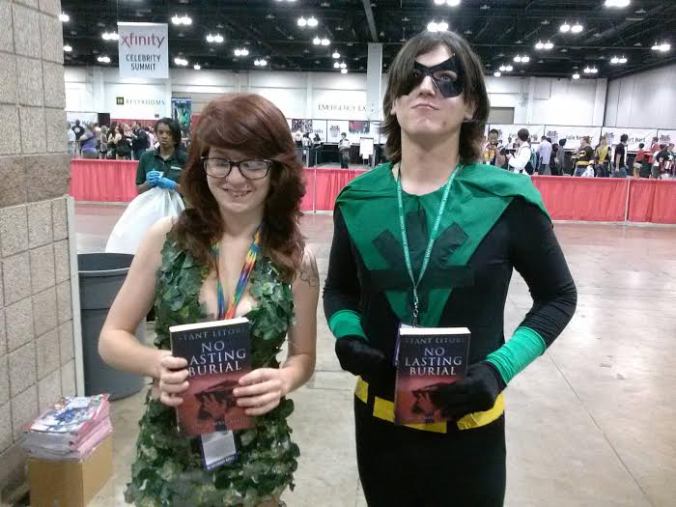
PoisonIvy

In the late afternoon, my heart was warmed to see villains and heroes
united by their newfound love for The Zombie Bible.

Child

She is a hero, too.

Batman

Batman had a copy, but he played it cool.

WheresWaldo

A fan I met at last year’s Denver Comic Con snapped this photograph
on Day Two this year, capturing me in it. In the tradition of “Where’s Waldo,”
can you find Stant Litore?

BeautifulWife_andPaintingbySierra

In a state of considerable exhaustion, I returned home to find a bottle of excellent wine, a very loving wife, and the surprise that she had framed a zombie portrait I acquired on Day One. The artist, Sierra, does fan art for The Walking Dead and I would love to commission her work. This portrait captures the type of emotion and evocative mood that I work with in The Zombie Bible. You can see that Vincent Gonzales signed the portrait, too, which was very kind of him.

My wife Jessica, my bride and my heart, is herself an incredible photographer … and very shy of being in front of the camera. When I returned home from Day Two of Denver Comic Con, she reminded just how blessed I am. She makes me feel like a superhero.

Day Three

Day Three was quieter. I signed many, many books, met many interesting people, and retreated into the back a few times for coffee and a comfortable couch. I fought to stay awake. But I had a wonderful time.

Litore_and_Olmos

Before the convention opened, I took a moment and met Edward James Olmos,
who I’ve always admired. I grew up loving his film Stand and Deliver,
about a math teacher fighting the good fight for inner-city children.
Later I discovered him in Bladerunner, Selena, and of course Battlestar Galactica.
He is a very kind man, and one of those rare actors — and rare people —
who have a gravitas that commands your instant respect.

And, of course, I also met more fascinating cosplayers on Day Three:

SilentBob

Silent Bob’s reaction to The Zombie Bible, while not exactly noisy,
was precisely the reaction I expected.

JackSparrow

Captain Jack Sparrow got completely lost in the story.
He wasn’t even frightened, just entertained.
But then, he has dealt with the wakeful dead before.

Frozen

These two Disney princesses loved the book so much
they simply couldn’t Let It Go.

CaptainAmerica

Captain America was so on edge with suspense that he took a moment’s pause
under his shield in the midst of battle to check what would happen on the next page.

Bane

I believe it was the series’ moments of horror and zombie mayhem
and splattered blood that got Bane’s adrenaline pumping.

Fly

For the Fly, it was the plenitude of rotting corpses. The Fly found those delicious.

ShepherdBook

Shepherd Book found it both troubling and intriguing. Once into it,
the novel’s passionate wrestling with stories that he cared about, too,
won him over. He also liked hearing that my daughters’ names
are River and Inara.

V

V was drawn in by the book’s deconstructionist and anarchic leanings.

EvilQueen

I’m actually wondering if I will regret presenting the Wicked Queen
with a copy. Her murmured response as she turned the pages was,
“What good ideas. What very good ideas…”

Thranduil

Thranduil of the Wood Elves was skeptical.
After all, the book was written by a human.

Batgirl_and_Supergirl

Batgirl and Supergirl found the series riveting.
They’ve always liked strong female characters.

BlackWidow_and_Bucky

Black Widow and Bucky Barnes appeared to consider the series
as a potentially hazardous object. But actually, is that a ghost
of a smile I see on Natasha’s face? It’s entirely possible that for
Black Widow, drawing her firearm is how she says “Hello.”

At least with people (and novels) that she respects.

HeMan

As for He-Man, well … he has the power!

Litore_and_Zombie_Extra

Toward the end of the day, things got dangerous again.

WeepingAngel

And still more dangerous! I blinked…

As I was leaving the Con, I was accosted by one final person: an eager and enthusiastic fan who hurried toward me, calling out, “Stant Litore! Stant Litore!” He caught me and quickly told me how much he loved my novels and how excited he was to meet me. He gave me his name and I plucked a book from my suitcase and signed it for him. He looked nervous and I am sure he worried that he was imposing on me, but the truth is that I was delighted. He reminded me of myself — both shy and eager in approaching people whose work I enjoy — and to be approached by a fan at a full run across a convention floor made me smile. It made me feel very good. It meant that, in at least one sense, I, and my novels, had “arrived.”

So, Adam, if you’re reading this, thank you. Thank you for reading my stories and for enjoying them, and for taking a moment in a very busy place to come tell me so. That really did mean a lot to me. Thank you.

I hope that all of you have enjoyed this photo-journal of my time at Denver Comic Con, and I hope to see you there next year! If you’re new to my fiction, I hope you’ll check out The Zombie Bible. And if you’re not into zombies, try The Ansible SagaYou will love these stories.

Yours,

Stant Litore

Stant Litore is a novelist. He writes about gladiators on tyrannosaurback, Old Testament prophets battling the hungry dead, geneticists growing biological starships, time-traveling hijabi bisexual defenders of humanity from the future. Explore his fiction here. And here is one of his toolkits for writers, and here’s another book where he nerds out about ancient languages and biblical (mis)translation. Enjoy!

Posted on 2 Comments

We Need Larger Hearts

Holding hands

I am livid. I just responded to an author who had posted the following text in a discussion of social justice for an oppressed minority: “Be grateful. This is a very good time and place (the US and the West, generally) for you. The govt supports you. Academia supports you, the cultural opinion makers support you, rogue judges support you at the expense of the Peoples’ will. So gays, stop your whining. You have a very good thing going, and more angry rhetoric and upthrust fists (in the air, I mean) put you past the point of diminishing returns. Through your overreach, you are making enemies you don’t need and otherwise wouldn’t make.”

I don’t even know how to process the small-heartedness of that attitude.

If you want to argue that homosexuality is a sin, fine, do that. I will refute you. In fact, argue anything you please, or anything you believe to be right. But regardless of your particular emotional response to or opinion of homosexuals, do not suggest, do not suggest for one moment that homosexuals have reason to be “grateful.”

Speaking here as a straight man, a religious man, and a married one, and one who is passionately a believer in the sanctity of marriage (though sometimes I wonder if I and certain pundits mean quite the same thing when we say that), what on earth are you talking about, when you say that gays are “whining” and should be “grateful”? Gay men and women should be grateful that they cannot visit their life partners’ hospital beds? That in some parts of the country they can’t raise children? That in some parts of the country they are at risk for being beaten and left bleeding on a barbed wire fence? For being raped repeatedly because a straight man decided to “convert” them into heterosexuals? Should they be grateful for a society that constantly judges them as inferior citizens? Should they be grateful for not being permitted to marry in most states of the Union? Should they be grateful that many of the producers of culture — such as the self-styled “award-winning novelist” who posted this — blithely, repeatedly dismiss their appeals for justice and for basic human decency in condescending and patronizing terms?

In the name of God, exposing injustice is never, ever an “overreach.” Challenging popularly-held untruths and making invisible, culturally sanctioned evils visible is never “whining.” If you believe otherwise, then I grieve for you, and hope fervently that some day your heart for your fellow human beings is a larger, more God-shaped heart.

Stant Litore

Stant Litore is a novelist. He writes about gladiators on tyrannosaurback, Old Testament prophets battling the hungry dead, geneticists growing biological starships, time-traveling hijabi bisexual defenders of humanity from the future. Explore his fiction here. And here is one of his toolkits for writers, and here’s another book where he nerds out about ancient languages and biblical (mis)translation. Enjoy!

Posted on 6 Comments

Thunderclap: Is It a Useful Tool for Writers? 4 Writers Answer.

One of my readers introduced me to Thunderclap, a social media tool that musicians, politicians, and celebrities sometimes use to get word out rapidly. A “Thunderclap” is a campaign that fans sign up for free — and then, at a designated time on a designated day, the Thunderclap tool sends out a message across all of your fans’ social media channels, simultaneously.

ThunderclapPictured here: Thunderclap and its elusive promise of teeming millions who will share your message.

If you are a writer — especially an indie writer — there are probably already wheels turning in your head, right? Get a blast out about a new release, or a literary event, or a temporary sale on one of your books. The idea of a “thunderclap” sounding across all social media channels also sounds attractive because we know that a high burst of simultaneous sales can have a powerful impact on Amazon’s ranking algorithms, which in turn can lead to more sales of our books.

The potential is certainly exciting.

So, in May, I decided to do an experiment, running a Thunderclap campaign to promote the release of my new science-fiction/weird fiction title Ansible 15715. I also told other writers about it, and three joined me in running experiments of their own.

Now we want to report back to you on how it went. In this post, you will hear from me (Stant Litore), from Robert Kroese (author of Mercury Falls, Schrodinger’s Gat, and Starship Grifters), Jodi McIsaac (author of the series The Thin Veil), and bestseller Cheryl Kaye Tardif (author of Children of the Fog, Whale Song, and many other bestselling thriller and YA titles).

Spoiler: Although our experiences varied, three of us were left unsatisfied, and the fourth would try it again, but with reservations.

Here are the details…

DOES THUNDERCLAP WORK FOR WRITERS?
FOUR NOVELISTS SHARE THEIR EXPERIENCE:

ManuscriptSTANT LITORE: “I tried to use the Thunderclap to simulate the telepathic distress call that is at the heart of my new release. So the idea was an attractive one — send out the distress call, with a link to the book, grab attention rapidly and maybe hit Amazon’s ranking algorithms hard. It was worth a try.

By giving the campaign its own time slot to work prior to other release-related promotions, I was able to check impact on book sales with some reasonable degree of certainty. I saw 10 sales per 100 supporters to the Thunderclap campaign — a very low return.

The campaign did prove effective in generating some enthusiasm among core fans on the day of — when the thunderclap went live — but it was a LOT of work to set up, and there are less work-intensive ways to rally fans for a release. Fans needed to be told what the Thunderclap tool was, whether it cost anything, and I really only got my 100 supporters by having more than 100 individual conversations inviting fans and colleagues to try the project with me.”

KroeseROBERT KROESE: “It’s VERY difficult to get people to support it. I eventually gave up. Stant Litore’s was successful, but I don’t think he saw huge results from it. My feeling is that it’s not worth the effort.”

(Stant’s note: Rob also tried to recruit Thunderclap supporters through his email newsletter, which has a pretty extensive following. Being a humorist, Rob introduced his call for support with the phrase “I Have the Clap!” … which is rather different than how I introduced my campaign. Neither of our approaches were that successful.)


McIsaacJODI McISAAC:
“I reached my goal of 100 (barely), and it was nice to give my friends and core fans a practical way to help on launch day, but I doubt it had any significant impact on sales compared to what Amazon Publishing does marketing-wise during the launch period. But I might do it again, because as I said, it’s a good way to engage your core group.”

CHERYL KAYE TARDIF: “As an author/publisher who enjoys experimenting with new ways to promote books, I decided to give ThunderClap.it a try. I set up a promo for DIVINE INTERVENTION, selecting the minimum of 100 supporters.

I ran the promo for over 6 weeks, tweeting it and mentioning it on FB and elsewhere. When my promo time was up, I had only reached 39/100 supporters and my promo was automatically cancelled, as per Thunderclap.it’s rules.

They claim my social reach was 84,153 people. Yet only 39 people responded.

Part of the problem was that many were nervous about the site automatically gaining information from supporters’ FB or Twitter accounts. Many would not support me because of this, even when I explained it was fairly standard, and even when I reassured them that the site wouldn’t do anything with that info.

So my overall rating based on my experience: 1/5 stars. I think it has potential, but they need to revamp the supporters’ end.”

CONCLUSION

Stant Litore again. I think that if Thunderclap is to work for you, you need to already be a celebrity — and by celebrity, I mean an actual celebrity, like Oprah, Stephen King, or J.K. Rowling. Cheryl is already ahead of the rest of us in this post in that her fan base is large enough that she was able to get 39 supporters for her Thunderclap just by mentioning it frequently in her feeds. I suspect that King or Rowling would get a multitude of people behind their Thunderclap in that way.

The rest of us — whether our Thunderclap went live (as it did for me and Jodi) or didn’t (as in Rob’s case) had to invest significant time in making personal invites to our readers and discussing the tool. That is a lot of effort.

If you do try the tool, I recommend having a team of volunteers ready at hand to recruit supporters for your Thunderclap campaign — just as you would do for a kickstarter or other crowdfunding campaign. That will help limit the time investment on your part — though you will still need to invest time in interacting with, motivating, and celebrating your volunteers, of course! And if you try it, I recommend treating Thunderclap as a way to engage some of your core readers, rather than as a tool that will generate sales.

But there are certainly other ways to engage and mobilize your core readers that will prove both less time-intensive and will show much greater return.

Yours in truth and fiction,

Stant Litore

Stant Litore is a novelist. He writes about gladiators on tyrannosaurback, Old Testament prophets battling the hungry dead, geneticists growing biological starships, time-traveling hijabi bisexual defenders of humanity from the future. Explore his fiction here. And here is one of his toolkits for writers, and here’s another book where he nerds out about ancient languages and biblical (mis)translation. Enjoy!

Posted on Leave a comment

New Release from Stant Litore!

Ansible15716_smallIt’s true. The second of the Ansible Stories is here. You can read it and enjoy it even if you haven’t read the first Ansible story, though if you’ve already read Ansible 15715, I think your enjoyment will be increased.

ANSIBLE 15716
Ansible 15715 was sent to a nightmare world that threatened to devour her, a world of endless dark. But the Ansible 15716 team is sent to a planet that burns beneath a white-hot sun … a saline desert where immense objects loom on the horizon, completely buried beneath a hundred meters of salt.

When this team’s sole survivor finds himself stranded in an alien body, among an alien race, he must search for some connection with home — or for some connection with this desert species, on a planet so vast, it makes the mind itself a desert.

Read Ansible 15716 here.

Posted on 1 Comment

Inara Finds Gruesome Battles Hilarious

InaraBaby Inara listens to death metal; it comforts her. And when I read her the Silmarillion, she giggles herself into hysterics during the battle and betrayal scenes. For example, tonight, during Nirnaeth Arnoediad, the Battle of Unnumbered Tears, she collapsed in hilarity when the dragon squished Azaghal king of the Dwarves, giggled herself silly when the Orcs bridged the stream of Rivil with their countless fallen dead, and squealed with delight as Hurin of the House of Hador hewed off the arms of the troll-guard, wielding a great ax two-handed. The smoking of troll-blood on the blade appears to bring her great joy.

She is clearly my daughter.

You can read more of the story of Inara in Lives of Unstoppable Hope.

Stant Litore is a novelist. He writes about gladiators on tyrannosaurback, Old Testament prophets battling the hungry dead, geneticists growing biological starships, time-traveling hijabi bisexual defenders of humanity from the future. Explore his fiction here. And here is one of his toolkits for writers, and here’s another book where he nerds out about ancient languages and biblical (mis)translation. Enjoy!

Posted on 1 Comment

Religion Should Be Like a Baby Bird

“Is your religion real when it costs you nothing and carries no risk? Is your religion real when you fatten upon it? Is your religion real when you commit atrocities in its name? Whence comes your downward degeneration from the original revelation?” – Frank Herbert, Children of Dune.

“It is perhaps one of history’s great ironies that the Church of later centuries fell so often into the same cultural dead ends that the early apostles abhorred, permitting reverence for the dead to take precedence over compassion for the living.” – Stant Litore, What Our Eyes Have Witnessed

These are various thoughts on what might go wrong with religion. Here’s a third, recent thought.

Religion, if it is to be both useful, alive, and vivifying, must be young and vulnerable as a baby bird, as something blossoming in the heart, a fragile but deeply attractive thing that seems, at least for a moment, to be “in the world but not of it,” an experience, a teaching, a relationship that calls out to you to protect the weak and to honor the divine. A still, small voice.

When religion is mighty and militant, it is very much “of the world.” Because we are moved to change our world, it is so easy to think that religion should be about power — the power to change things, to enforce God’s will or our own — when it was never so for the prophets or for Jesus of Nazareth. For them, it was never about power. It was about the weak voice, the insistent voice, the voice crying out in the desert, the voice that you can dampen by turning up your MP3 or even by cranking up the volume on your worship music, but the voice that keeps calling your name anyway, working its way into your heart, asking not to be ignored, asking for your action, for your justice, for your advocacy for others, for your repentance, and for your love. Religion is not about shouting or legislating or campaigning. It can motivate these things, but the one should not be mistaken for the other! Religion was meant to be about listening.

Listening for that quiet voice.

Encouraging others to listen.

When religion becomes a force of evil in our culture, a force of destruction and humiliation and the defeat of the human spirit, I think it is because we forget to listen. Our religion becomes a shout, a battle hymn, a militant cry. It becomes the strong right arm of the world. It becomes the very thing it was founded to disrupt and redeem.

I have seen a meme going around that says “I am a Christian: you may beat me, imprison me, or kill me, but you cannot change my mind.” I find everything about that message abhorrent. In Christianity, it is the FUNCTION of Christianity to repeatedly, daily, hourly change your heart, change your mind, change and reform your very identity. Christianity was founded as a religion of and for change. Its teachings are about challenging stagnation and “hardness of heart.” In that faith tradition, one should hold fast to a trust in God’s goodness, but one’s mind and heart should be subject to change at any moment. “Metanoia” – the change of the heart – that is the whole point of it. The reason our sacred texts put such emphasis on “faith” is because it takes enormous trust to live willing to have your life, your beliefs, your assumptions, and your loyalties constantly questioned, reformed, transformed, turned upside down and around and around at the insistence of God’s still, small voice.

Notice the disciples in our own sacred texts. At their best, they are shown listening. Learning. And the model for “evangelism” in the New Testament is not a radio show but having meals together, listening to each other and sharing stories and sharing the words that blaze in our hearts, writing and reading personal letters, and listening in humility.

We are no longer a nation of listeners. We are a people more frequently led by fear than faith; we bludgeon each other with our political views, our religious creeds, our ideological positions. We walk into conversations wearing them like bulletproof vests, with sound-dampening muffs over our ears, guarding our hearts against any chance of hearing the hearts of others.

That is what I am thinking about this morning.

Stant Litore

Stant Litore is a novelist. He writes about gladiators on tyrannosaurback, Old Testament prophets battling the hungry dead, geneticists growing biological starships, time-traveling hijabi bisexual defenders of humanity from the future. Explore his fiction here. And here is one of his toolkits for writers, and here’s another book where he nerds out about ancient languages and biblical (mis)translation. Enjoy!

Posted on 26 Comments

The Story of Inara

WINTER 2021: THE UPDATE

Inara has had a setback early this year – a hospitalization after nearly dying – but now she is thriving again. And – best news – we have a definitive diagnosis at last: an error in gene RHOBTB2, a diagnosis she shares currently with just nine other children in the U.S. But now that we know to test for it, many more mystery children like Inara will be able to get diagnoses – and more targeted care. Other parents of children like Inara won’t be wondering in the dark with no idea what’s ahead for their child or why their child has suffered. I wrote about this in the expanded second edition to Lives of Unstoppable Hope, after what has been a long winter. Long may our dragon daughter soar! (And roar.)

SPRING 2018: THE UPDATE

We are climbing now, too. Behold the triumph of Inara, who was called “the girl who will never walk” but who decided to be a fierce and all-devouring dragon instead of that.

Inara-Triumph

FALL 2016: THE BIG UPDATE!

Guess who’s walking!

Inara

That’s right. We were once told that Inara wouldn’t survive her first year. We were once told she would never stand. We were told she would never walk. She is now taking tentative unassisted steps and lots of assisted steps. Over a year seizure-free and ready to take on the world.

Here she is standing:

inara1

inara2

And, with a little help from her wheelchair, exploring the world. Girls in wheelchairs explore the world, too. Especially this one!

inara4

Inara triumphant!

THE BACKSTORY

inara3

My Daughter, the Fierce-Hearted

Helloworld_InaraInara is partially blind, with scarring in her brain and a history of severe seizures. She is also one fierce, dragon-hearted little girl. She is named for a character from Firefly who approached all things in life with both grace and intensity; nothing keeps Inara down, and in our home, she is triumphant.

Readers who are new to my work have asked me lately about Inara, and I thought I would collect the pieces of her story here.

Inara_Hospital_4

Woven into her story is the story of my books and how I came to bring them to you; the story of my wife and our love for each other and for our children; and even the quiet patience and exuberant big-sisterness and caring of River, my oldest daughter. You can read about Inara and her family in the book Lives of Unstoppable Hope and in these old blog posts, too:

“Update on Inara’s Story; Also, Why Late at Night When Everyone is Asleep I Write So Fiercely and Fast”
“Dragon at the Hospital: Day One”
“Big Update About Inara!”
Inara and the Giraffe Club
How the Kindle and KDP Helped Save My Little Girl

Inara and I cope with the more difficult moments by sharing stories:

Preparing for the Long Dark of Moria
The Night I Stayed Up All Night with My Daughter

December 29, 2015 update:
Today, as I update this blog — today is December 29, 2015 — Inara is growing more able by the week. She has been seizure-free for some time; we hope to keep her so, though we know each month is a new creation. Yet we are so inspired by her. Though she isn’t speaking yet, she has developed a deep vocabulary of nonverbal communication — both gestures and sounds — and she can communicate her needs and feelings. She is artistic, painting with her hands and feet. She is standing (at one time we were told she would never stand) and taking a few assisted steps; we are confident that sometime in 2016, she will be able to do at least some walking. She has more fine motor and problem solving skills now. She is tempestuous, capable of fierce tantrums and fits of uncontrollable giggles. And she is smart. Dear readers, she is so smart. I am so proud of her.

As they say on Firefly: Inara has done the impossible, and that makes her mighty.

I am so proud of her and her sister. And also so grateful for all those — readers, friends, doctors, nurses, specialists, church members, fans and Patreon members — who gathered around us when things were touch-and-go. You all made an enormous difference.

Lives of Unstoppable Hope

I wrote down a lot of what I felt as a father during the dark season. In 2015, I released that memoir as Lives of Unstoppable Hope. I’ve been told that the book is inspiring; a pastor in Oklahoma ordered copies for his entire church. Though the framework for the book is a study of the Beatitudes in ancient Greek as a way to explore “hope,” I’ve been told by a diversity of readers — religious and atheist alike — that the book was inspiring and moving.

Lives of Unstoppable Hope is the story behind all the stories I have written.

If you would like to check it out, here it is:

UnstoppableHope_Ebook_Final_1000

In friendship,

Stant Litore and family

Posted on 1 Comment

Father Polycarp’s Gaze

Polycarp

The frontispiece for What Our Eyes Have Witnessed. Polycarp’s gaze.
Photography by Danielle Tunstall. Model: Martyn Dalzell.

…her eyes opened to him, and he gazed inside the rooms of her heart, as he so often had gazed into the eyes of the walking dead. He saw rooms that were locked and chained; he could almost hear the screams behind those shut doors. He saw other rooms that were vast and wide as oceans; in one, her love and faith in him, a faith so profound and unshakable that it shook him to see it. In another room, the many moments when she’d held others in her arms and given them refuge, and the love, deep and maternal and fierce, that she bore now toward each of those she’d sheltered. He saw her loss at having borne no children, and her joy at having found children in the men and women who lived in the insula under Polycarp’s care. He saw her determination to preserve them – and him – a resolve that was like a hard, cold wall of rock in her heart. 

– What Our Eyes Have Witnessed

726c3-woehw_cover_litore

That is Father Polycarp gazing into the eyes of Regina Romae, who is the heroine and probably the true protagonist of What Our Eyes Have Witnessed, a novel of the early martyrs’ encounter with the undead in second-century Rome.

But Polycarp doesn’t look into the souls of the living only.

Polycarp has a Gift. He can bring peace and rest to the restless dead. At his touch, each hungering corpse lies still at last. But to do this, Polycarp must first look into each one’s blind eyes and find the remnant of the soul caught within the shambling corpse. He must witness its secrets, its suffering — all that it loved and feared and regretted in its brief life. Only then can he absolve that soul and set it free. Only then will it cease to walk and feed.

Read more in this captivating installment in The Zombie Bible.